

When Sydney’s Spring Thunder Meets the 24 Solar Terms
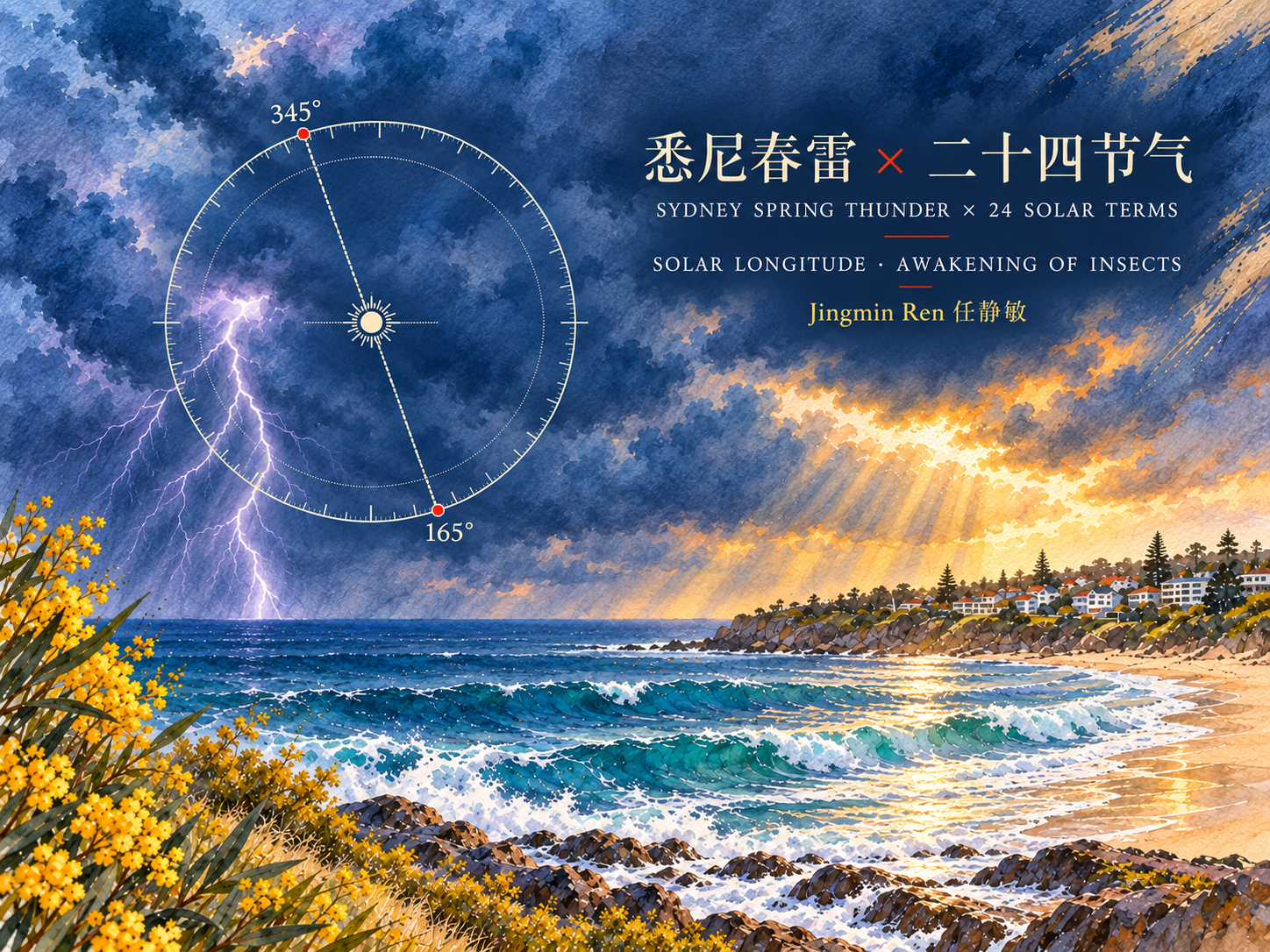
Sydney in early spring: observing thunder, changing weather, and the Twenty-Four Solar Terms from a Southern Hemisphere perspective.
悉尼早春:从南半球视角观察春雷、天气变化与二十四节气。
When Sydney’s Spring Thunder Meets the 24 Solar Terms
Sydney has entered early spring in the Southern Hemisphere. Recent warmer temperatures, changing winds, and rolling thunder have led me to reconsider how the Twenty-Four Solar Terms may be compared and translated across hemispheres.
On 7 September, the Sun reached solar longitude 165°. In the traditional Solar Terms system, developed through Northern Hemisphere seasonal observation, this position is known as Bailu, or White Dew. It usually signals a transition towards cooler autumn conditions. Yet in Sydney, the same astronomical coordinate corresponds to a very different landscape: temperatures are rising and nature is gradually awakening into spring.
From Bailu to Jingzhe
If a 180° seasonal-phase translation is applied between the Northern and Southern Hemispheres, solar longitude 165° corresponds seasonally to 345°—Jingzhe, commonly translated as Awakening of Insects.
Jingzhe is traditionally associated with warming temperatures, the arrival of spring thunder, increasing rain, and the renewed activity of plants and animals. Sydney’s recent thunder and changing weather therefore create an intriguing correspondence with the early-spring characteristics expressed through Jingzhe.
At around the same time, a neighbour mentioned seeing a small snake in their backyard. Reptile activity is influenced by temperature, so this chance encounter offers another subtle, local observation of life responding to the arrival of spring.
Observation, Not Proof
One thunderstorm, a period of warmer weather, or a single encounter with a snake cannot independently prove a seasonal theory. These moments can, however, provide valuable points of observation. They invite us to consider how traditional seasonal knowledge might be compared, translated, and renewed through direct experience in a different hemisphere.
This distinction is important. My research does not simply transfer Northern Hemisphere seasonal names onto the Southern Hemisphere. Instead, it uses solar longitude as a shared astronomical coordinate while allowing seasonal meaning to emerge through local climate, ecology, landscape, and lived experience.
Solar Longitude and Spatial Time
This inquiry lies at the centre of my public artwork Solar Longitude–Time Orbit at Bondi Sea Wall and my continuing Spatial Time research.
The astronomical position of the Sun can be shared globally, but seasons are experienced locally. The same solar longitude may correspond to autumn in one hemisphere and spring in another. Through public art, sculpture, Chinese calligraphy, seal impressions, and continuing observation, I explore how a shared structure of time can hold multiple seasonal and cultural perspectives.
The Same Solar Longitude. Different Seasons. Different Landscapes. One Shared Rhythm.
— Jingmin Ren 任静敏
Interdisciplinary Artist · Spiritual Energy Artist
当悉尼春雷遇见二十四节气
悉尼已经进入南半球的早春。近日气温回升、风势变化与一声声春雷,让我再次思考二十四节气如何在不同半球之间被比较与转译。
9月7日,太阳运行至黄经165°。在源于北半球季节观察的传统二十四节气体系中,这一位置被称为“白露”,通常意味着天气开始转凉,季节逐渐走向深秋。然而在悉尼,同一个天文坐标所对应的却是截然不同的景象:气温正在回升,自然生命逐渐从冬季走向春天。
从白露到惊蛰
若将南北半球之间180°的季节相位转换纳入观察,太阳黄经165°在季节意义上对应黄经345°——“惊蛰”。
惊蛰通常与气温回升、春雷初响、降雨增加,以及动植物重新活跃有关。悉尼近日出现的春雷与天气变化,因而与惊蛰所描述的早春特征形成了一种引人思考的呼应。
与此同时,一位邻居谈到近日在自家后院见到一条小蛇。蛇类活动会受到气温变化的影响,这次偶然的相遇,也成为悉尼早春生命逐渐活跃的一个细微而具体的在地观察。
观察,而非证明
一次雷雨、一段时间的气温回升,或一次与小蛇的偶然相遇,都不能独立证明一种季节理论。然而,这些时刻可以成为有价值的观察点,使我们重新思考传统季节知识如何在不同半球、气候和生态环境中被比较、转译与更新。
这一点十分重要。我的研究并不是把北半球的传统节气名称直接移植到南半球,而是以太阳黄经作为共享的天文坐标,同时让季节意义通过地方气候、生态、景观与生活经验自然显现。
太阳黄经与空间时间
这正是我的邦迪海堤公共艺术作品《太阳黄经-时间轨道》及“空间时间”研究持续探索的核心。
太阳的天文位置可以被全球共享,但季节始终在具体地域中被感受。同一个太阳黄经,在一个半球可能对应秋季,在另一个半球却对应春季。通过公共艺术、雕塑、中国书法、印章与持续的自然观察,我尝试探索一个共享的时间结构如何容纳不同的季节经验与文化视角。
同一个太阳黄经,不同的季节,不同的景观,共享的节律。
— 任静敏 Jingmin Ren
跨学科艺术家 · 灵性能量艺术家
Explore the research behind Solar Longitude, the Southern Hemisphere Seasonal Reading, and Spatial Time.
进一步了解“太阳黄经”、南半球季节阅读与“空间时间”研究。